9-trees.mdx
3 min read
General
Data Structures - Trees
By Haffi Mazhar · 3 min read
In this post, I'm going to be defining what a tree is in the framing of data structures, the properties that make it a tree, common implementations and different ways of traversing a tree.
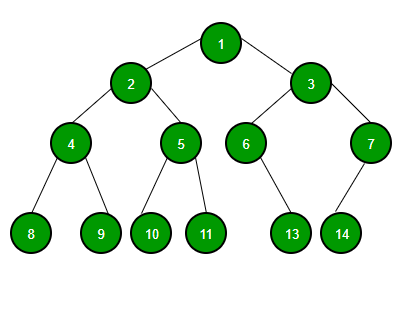
Main
To understand a tree, we also need to be aware of graph data structures (link to graph post). TLDR is, a graph is a collection of vertices (aka nodes) and edges that connect these vertices. Edges represent relationships or connection between nodes. Graphs can be directed or undirected, basically either the edges have a specific direction or not.
Due to the direction property on edges, there can be a cycle between nodes, i.e two nodes which both direct to each other. This brings us to tree
Properties of trees
A tree is a special type of graph that is connected and acyclic, meaning that there no cycles between the nodes in the graph. Between two nodes, there is always a unique path.
Each tree has a single node known as the 'root'. This is the starting point for any method of traversing the tree.
Each child nodes is a 'sub-tree'. Meaning, each node can have child nodes.
Types of trees
A tree can be binary or non-binary.
- A binary tree, each node has at most two child nodes
- A non-binary tree, each node can have any number of child nodes
Applications of trees
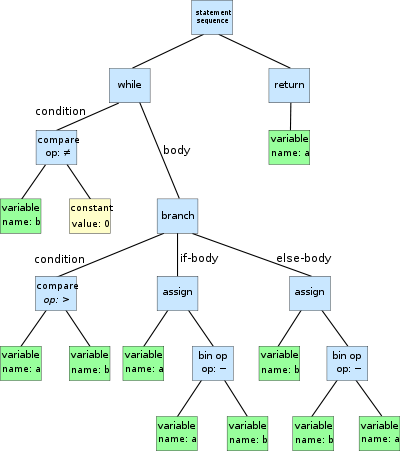
Binary trees are commonly used in searching or sorting problems. Another good example of a binary tree is an abstract syntax tree, which is a tree representation of expressions and text in code.
An example of non-binary tree is a file-system. A directory can have any number of sub-directories where each sub-directory is a sub-tree.
Ways of traversing a tree
Linear data structures such as Array, Linked List, Queues, Stacks only have one logical way to traverse them.
However, trees are a non-linear data structure. Therefore, can be traversed in different ways. The following are common methods:
- Pre-order traversal
- In-order traversal
- Post-order traversal
Example tree:
      1
    2   3
   4 5
Pre-order traversal
Pseudo-code algo:
- Visit the root
- Traverse the left subtree. Recursive call to Pre-order(left subtree)
- Traverse the right subtree. Recursive call to Pre-order(right subtree)
# A function to do preorder tree traversal
def printPreorder(root):

    if root:

        # First print the data of node
        print(root.val)

        # Then recur on left child
        printPreorder(root.left)

        # Finally recur on right child
        printPreorder(root.right)
Example: Pre-order traversal for the above-given figure is 1 2 4 5 3.
Complexity:
Time: O(N), we have to visit each node at least once Space: If we consider the size of the call stack for function calls, then it's O(h) where h is the height of the tree. If we don't, then it's O(1) because we don't need to store anything extra if we're just visiting the node
Use-cases
Pre-order traversal is used to create a copy of the tree
In-order traversal
Pseudo-code algo:
In-order(tree):
- Traverse the left subtree. Recursive call to Pre-order(left subtree)
- Visit the root
- Traverse the right subtree. Recursive call to Pre-order(right subtree)
# A function to do preorder tree traversal
def printPreorder(root):

    if root:
        # Then recur on left child
        printPreorder(root.left)

        # First print the data of node
        print(root.val)

        # Finally recur on right child
        printPreorder(root.right)
Example: In-order traversal for the above-given figure is 4 2 5 1 3.
Complexity:
Time: O(N), we have to visit each node at least once Space: If we consider the size of the call stack for function calls, then it's O(h) where h is the height of the tree. If we don't, then it's O(1) because we don't need to store anything extra if we're just visiting the node
Use-cases
In a BST (Binary search tree). Where a left subtree nodes are always less than the root, the right subtree nodes are always greater than the root, and each subtree of is also a BST.
In order traversal gives the nodes in a non-decreasing order. To get nodes of BST in non-increasing order, a variation can be used where the traversal is reversed can be used. i.e recurse on right subtree first, print node, then recurse left subtree
Post-order traversal
Pseudo-code algo:
Post-order(tree):
- Traverse the left subtree. Recursive call to Pre-order(left subtree)
- Traverse the right subtree. Recursive call to Pre-order(right subtree)
- Visit the root
# A function to do preorder tree traversal
def printPreorder(root):

    if root:
        # Then recur on left child
        printPreorder(root.left)

        # Finally recur on right child
        printPreorder(root.right)

        # First print the data of node
        print(root.val)
Example: In-order traversal for the above-given figure is 4 5 2 3 1.
Complexity:
Time: O(N), we have to visit each node at least once Space: If we consider the size of the call stack for function calls, then it's O(h) where h is the height of the tree. If we don't, then it's O(1) because we don't need to store anything extra if we're just visiting the node
Use-cases
Post order traversal is used to delete the tree.